Indonesia is one of the world’s largest coconut producers. In 2000, coconut plantations covered an area of 3.76 million hectares, with an estimated total production of 14 billion coconuts, the majority (95%) of which came from smallholder farms. Coconuts hold significant economic, social, and cultural value.
The utilization of coconuts generally focuses on by-products such as copra, oil, and coconut milk for household consumption, while other by-products like coconut shells remain underutilized. The shell constitutes about 12% of the coconut’s weight. Therefore, with an average annual coconut production of 5.6 million tons, approximately 672,000 tons of shells are produced. The large-scale potential of coconut shell production has not been maximally harnessed for value-added production activities.
One product derived from coconut shells is charcoal, which can be further processed into activated carbon. Thus, coconut shell charcoal serves as a raw material for the activated carbon industry. Despite the substantial potential of raw materials, applications, and market demand, only a limited number of people are engaged in producing coconut shell charcoal.
From a technological standpoint, processing coconut shell charcoal is relatively simple and can be carried out by small-scale enterprises. However, constraints such as limited funding, restricted access to market information and networks, as well as unsatisfactory product quality, pose challenges and obstacles in developing the coconut processing business.
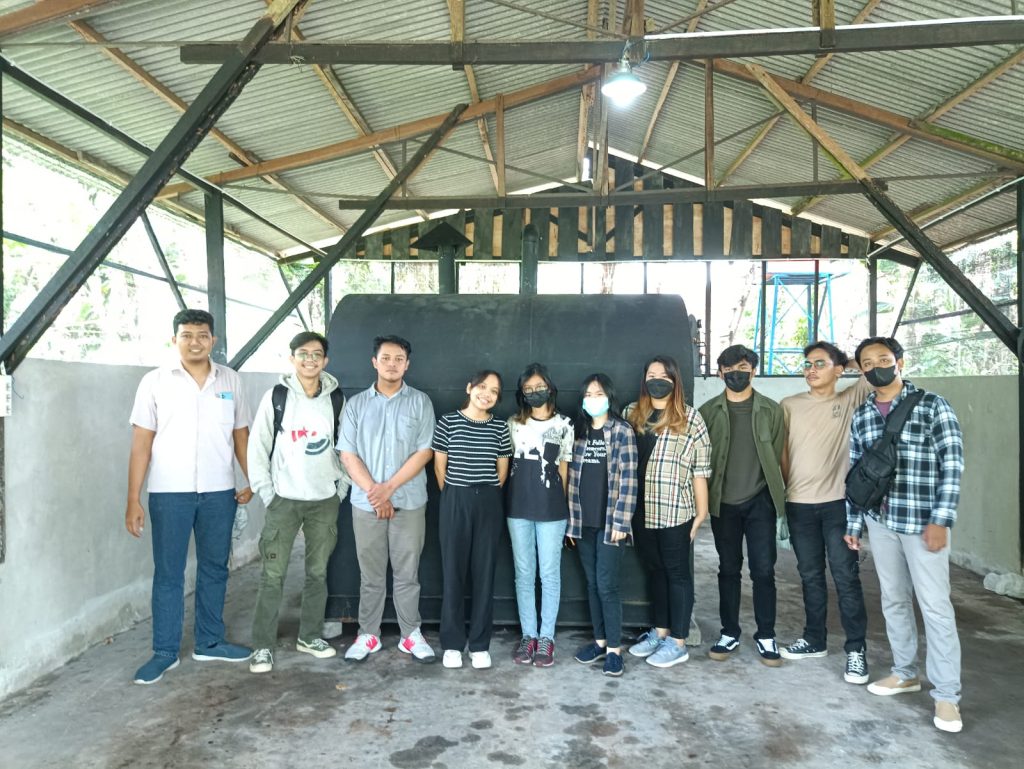
In this study, students used a Carbonizer machine equipped with a combustion furnace, a liquid smoke collector, and several other components that support the coconut shell charcoal production process. The research was conducted through experimentation and observation of the Carbonizer machine, with attention given to the amount of fuel used and the intensity of the flame in the furnace.